-
Memory Games

-
Simon Games
- Simon game
Simon game - Online and Free


Play the Simon game



Online Simon game

This Simon game is the online version of the classic electronic Simon game from the 1980s. It features a circular shape with 4 large colored light-up buttons: one red, one green, one blue, and one yellow. Each button is paired with a distinct electronic sound to help you memorize the sequence of lit buttons. If you've never played it before, you're in for a treat!
How to play:
To start the game, press the "PLAY" button. At the top of the game, a message will guide you. When the Simon is playing, it displays the message "WATCH" and when it's your turn to play, it displays "PLAY". Each time you correctly reproduce a series, your score increases by one point and the Simon adds a new key to the sequence, increasing the difficulty. As soon as you make a mistake, you've lost and the game is over! This online Simon game also features a TRAINING mode, which is more forgiving — if you make a mistake, the Simon shows you the series again, as many times as needed.
Find the Simon game rules below.
Features of this online Simon game:
The features listed below are common to all our online Simon games.
GAME mode or TRAINING mode
- Simon GAME mode: The game ends as soon as the first mistake is made.
- TRAINING mode: In this mode, mistakes are allowed. If you make a mistake, the Simon will show you the series again.
Note: Each of these 2 modes has its own
"High score". If you wish, you can reset your high scores to 0 using the
"RESET" button.
Choice of SPEED (or DIFFICULTY LEVEL)
The difficulty level depends on the speed at which the Simon game displays the series. The default mode is "AUTO".
- AUTO: The sequence speed, slow at first, will gradually increase as the game progresses.
- SLOW: The Simon displays the series slowly, giving you more time to observe and memorize. This is the EASY level.
- NORMAL: The Simon displays the series at normal speed. This is the MEDIUM level.
- FAST: The Simon displays the series at fast speed. This is the HARD level.
Note: If you're a beginner, we recommend
starting at "SLOW" speed and working your way up once you feel
more comfortable.
Choice of SOUND
In our online Simon game, you can choose between several types of key sounds. By default, the ELECTRONIC sound is selected. Feel free to try out the other sounds available:
- 80'S: A sound recorded from the first edition of the MB® game in 1978.
- PIANO: Piano key sounds (notes C, D, F, E).
- XYLOPHONE: A xylophone sound with wooden keys.
- METALLOPHONE: A xylophone sound with metal keys.
- ORGAN
Note: If the sound distracts you
or breaks your concentration, you can mute it using the button at the
top right.
Tracking your progress
- SCORE: Your current game score is displayed at the top left.
- HIGH SCORE: Your high score is displayed at the top right. It's stored in your browser using cookies, so you can track your progress over time. When you beat your high score, the Simon will congratulate you at the end of the game. You can reset your high score to 0 using the "RESET" button.
Why play the Simon game?
A memory and attention game
Simon is the ultimate memory game! It also
stimulates attention — because without focus, memory will never reach
its full potential. Depending on the player, the memorization mechanisms involved include
visual memory (colored light-up keys), auditory memory
(key sounds), or both! All of this makes it a fantastic tool for
training your memory.
A random game
Since the sequence of keys is randomly generated, every game is different — you can
play again and again without ever getting bored!
Like all the other games on Memozor, this online Simon game is free,
unlimited and compatible with all your devices. Feel free to try it on your tablet
or smartphone.
Frequently Asked Questions
How does Training mode work?
Training mode is more forgiving than the classic Game mode. If you make a mistake, the Simon doesn't stop — it shows you the series again, as many times as needed, until you reproduce it correctly. It's the perfect mode for learning to play or improving at your own pace. Note that each mode has its own high score, tracked independently.
Can you choose the difficulty level?
Yes! The difficulty level is determined by the speed at which the series is displayed. Four options are available: AUTO mode (progressive speed, recommended by default), SLOW (easy level, ideal for beginners), NORMAL (medium level), and FAST (hard level). If you're just starting out, we recommend beginning at SLOW speed and working your way up gradually.
Can you change or mute the sound?
Yes! Our Simon game offers 5 different sound options for the keys: Electronic (default), 80's (recorded from the original 1978 MB® edition), Piano, Xylophone, and Metallophone. You can also mute the sound at any time using the button at the top right of the game, if it distracts you or breaks your concentration.
Is the Simon game good for your brain?
Absolutely! Simon is much more than a fun game — it's a great workout for your memory and attention. It engages both visual memory (the colored light-up keys) and auditory memory (the sounds associated with each key). The more you play, the better you get at holding longer and longer sequences in your head. And like all Memozor games, it's 100% free and unlimited.
Does the Simon game ever end?
In theory, the Simon game is endless! A new key is added to the sequence with every round, meaning the game can go on indefinitely... as long as you don't make a mistake! In practice, it's human memory that sets the limit. The best players can memorize sequences of 20 to 30 keys, which is already an impressive feat!
Where can I buy a real Simon game?
Nothing beats the real thing! You can find the Simon game at
most major toy retailers —
Amazon.com carries a wide
selection, including the classic version and several special editions. For 80s nostalgia
fans, vintage second-hand Simon games are available on sites such as
eBay.com,
Etsy.com, or
Mercari.com.
A word of warning though: prices can be eye-watering — sometimes hitting $400 to $500
for early editions! The re-release of the original Simon® by Hasbro remains a great
alternative, available for around $20.
The Simon® game rules
The principle of the game is simple: the player must memorize the sequence
of light-up keys randomly generated by the Simon game and
reproduce it in the correct order. The goal is to reproduce the longest
possible sequence of colors and sounds using memory and focus. In theory it's a never-ending
game — but human memory has its limits!
A new key is added to the sequence each round, so the difficulty steadily increases as
the player's memory is put to the test more and more.
- 1- At the start of the game, one of the 4 keys lights up at random, simultaneously emitting the sound associated with that key.
- 2- It's then the player's turn to press the same key.
- 3- In the next step, the game lights up the same key again, then lights up a second one, again chosen at random.
- 4- The player must reproduce this light sequence from memory.
- 5- And so on... Each round, the Simon adds a new key to the end of the sequence, making the game progressively harder.
- 6- The game ends as soon as the player makes their first mistake — i.e., presses
the wrong key. As long as no mistake is made, the game goes on.
Origin and history of the electronic Simon® game
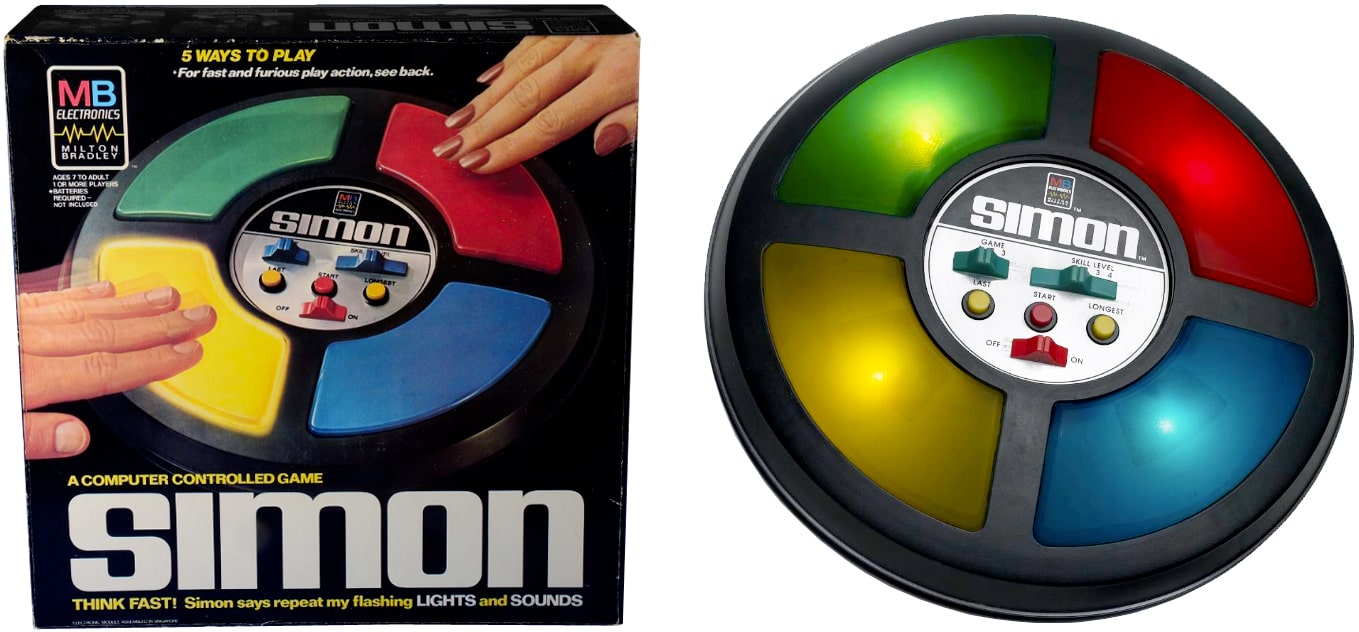
The Simon®... A legend that lives on! This iconic memory game
from the 80s celebrated its 40th anniversary in 2018!
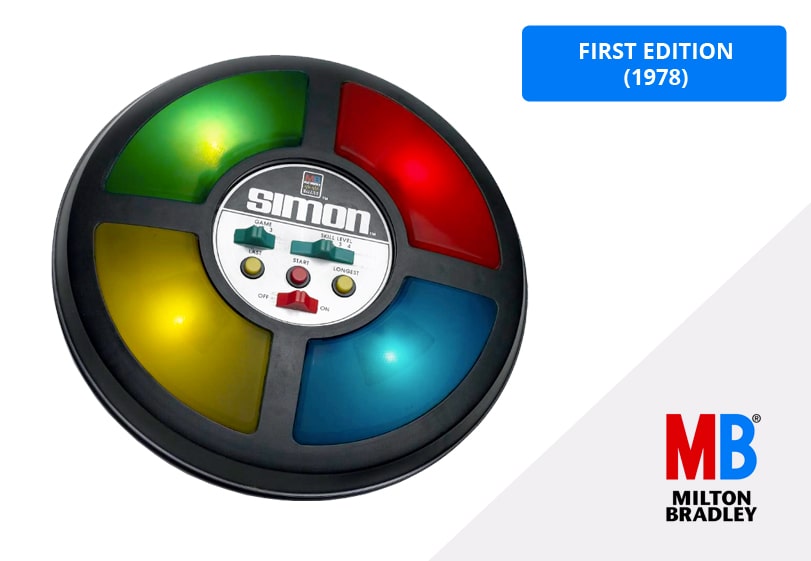
The very first edition of the Simon game featured a
circular electronic design with 4 large light-up buttons
in four colors: red, green, yellow, and blue. It was released by
Milton Bradley (MB) in 1978 under the trade name
Simon®.
Did you know that the Simon game takes its name from the classic children's game
"Simon says"? If you'd like to learn more about it, check out the
"Simon says" game
section below.
The game's notes — E, C#, A, and a lower E — were not chosen at random. They were
carefully picked to produce a harmonious melody, no matter what order they're played
in.
The inventors of the Simon game are
Ralph H. Baer and
Howard J. Morrison, both
renowned designers behind several best-sellers in the
toy industry. Howard J. Morrison co-created titles such as Ants in the Pants®,
Guesstures®, Brain Warp®, Hot Wheels Criss Cross Crash®, and many more.
Ralph H. Baer, more focused on video games, is the father of the
Magnavox Odyssey® — the first commercially released home video game
console.
Two other versions followed the original Simon®:
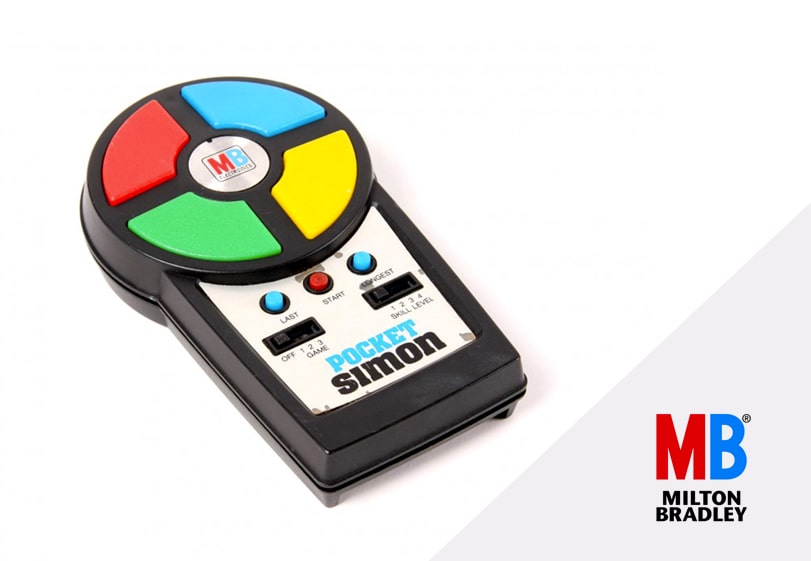
- The Pocket Simon® from the 80s — smaller and easier to carry around than the original.
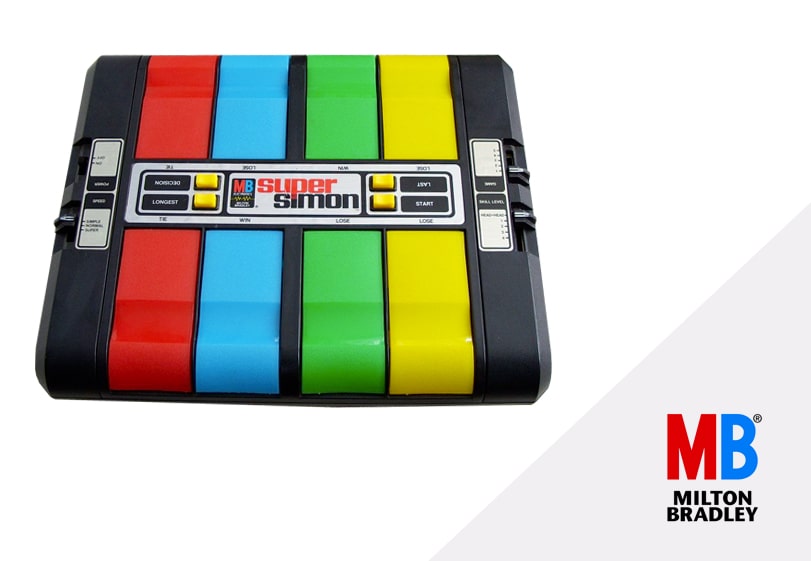
- The Super Simon® from the 80s,
featuring a rectangular case with 8 keys (the same four colors — yellow, blue, green,
red — each appearing twice). With this game, Hasbro introduced multi-player
functionality for the first time.
In 1984, Hasbro acquired Milton Bradley for $360 million and went on to release new versions of the Simon game. Here are the most notable ones:
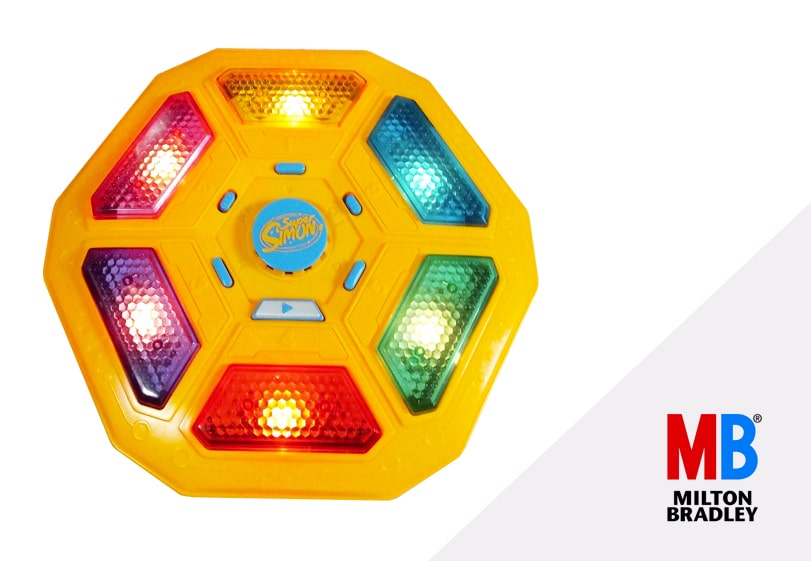
- In 2003, a new Super Simon® appeared, featuring a yellow case with 6 light-up keys and two brand-new button colors: pink and purple.
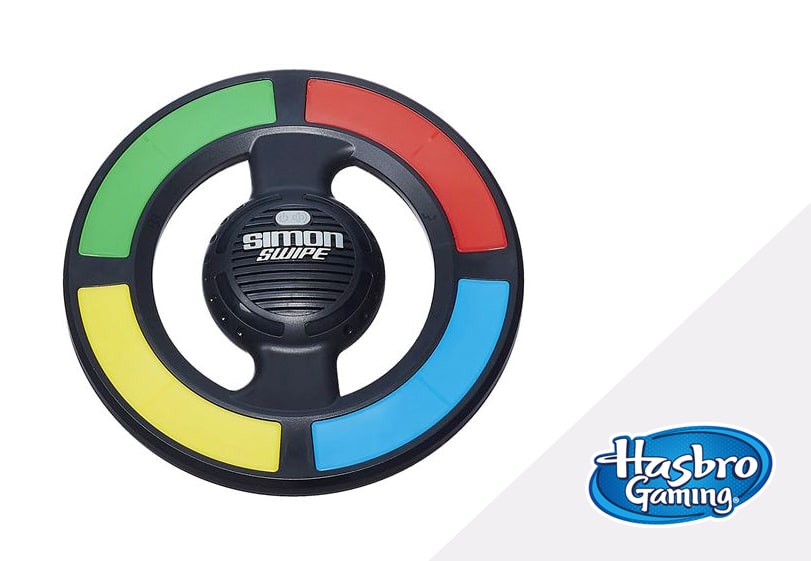
- In 2013, Hasbro innovated with the Simon Swipe® — circular in shape, resembling a steering wheel with 8 touch-sensitive buttons. No more pressing; a simple swipe was all it took.
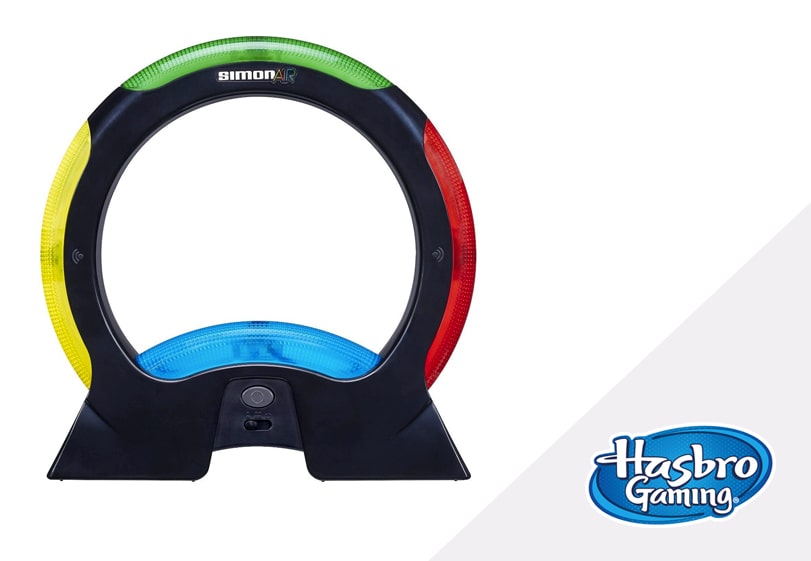
- In 2016, the Simon Air® arrived. Hasbro had the brilliant idea of adding motion sensors, letting players reproduce the light sequence by waving their hands over the buttons — without ever touching them. Hence the name!
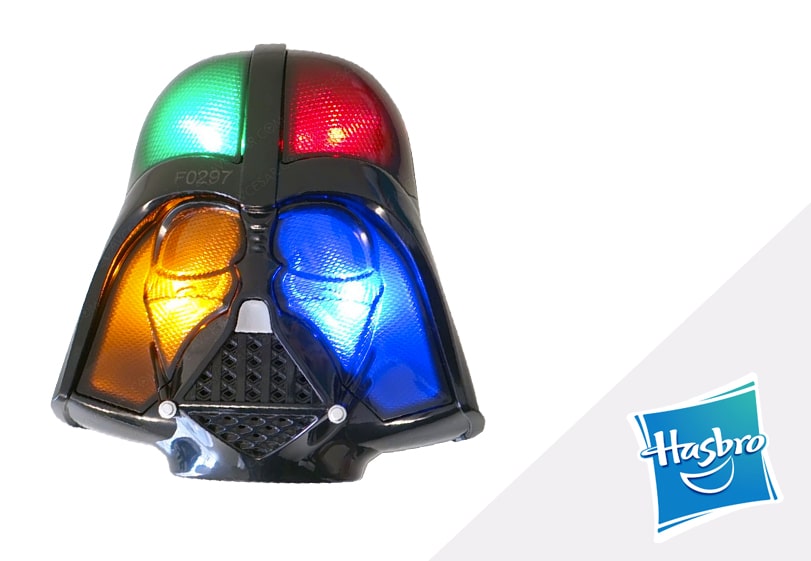
- In 2017, a Star Wars-themed Simon made its debut: the
Simon Darth Vader®. Built around a
Darth Vader mask with R2-D2 sounds, it's a must for any Star Wars fan...
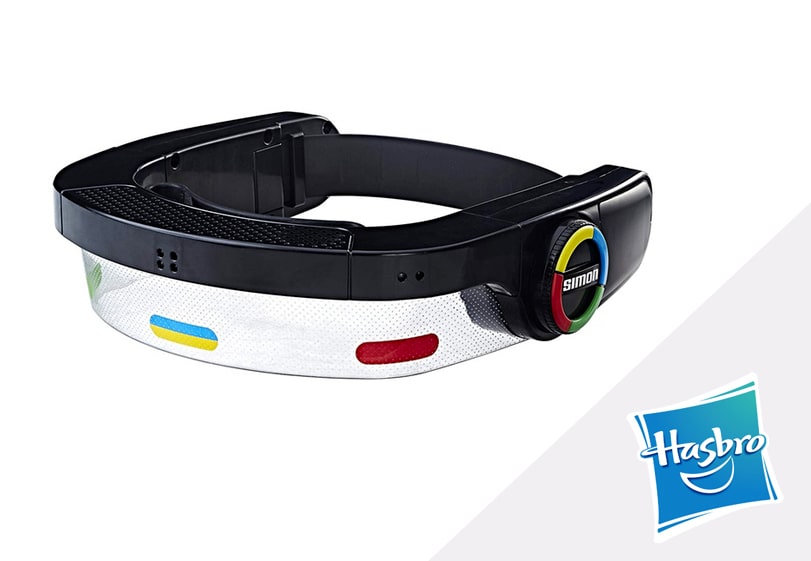
May the force be with you :) That same year, Hasbro also launched the
Simon Optix®, undoubtedly the most
technologically advanced edition yet! It's a headset with motion sensor technology,
similar to the Simon Air. Players reproduce the sequence by moving their hands
in the correct order, solo or with friends.
The original Simon® can still be found today. Some sites sell
vintage second-hand Simon games, though prices can be eye-watering —
sometimes reaching $400 to $500 for early editions! For 80s nostalgia fans, Hasbro's
re-release of the original Simon game under the same name is still
available for around $20.
Simon® through the years — the main editions:
-
 Simon Original vintage
First edition 1978 MB® -
 Simon Pocket
80s Vintage game MB® -
 Super Simon vintage
80s Vintage game MB® -
 Super Simon
Edition 2003 Hasbro® -
 Simon Swipe
Edition 2013 Hasbro® -
 Simon Air
Edition 2016 Hasbro® -
 Simon Darth Vader
Edition 2017 Hasbro® -
 Simon Optix
Edition 2017 Hasbro®
The "Simon says" game
The "Simon says" game is the English-speaking equivalent of
"Jacques a dit" in French-speaking countries, "Jean dit"
in Quebec, or "Simón dice" in Spain. It's this classic children's game
that gave the famous Simon® its name.
In the game, one child gives instructions to the others — this child is called
"the Simon".
For example, the instructions might be:
- "Simon says: Make a funny face!"
- "Simon says: Raise your right arm in the air!"
- "Stamp your feet two times!"
- "Simon says: Blink!"
- "Shout as loud as you can!"
- "Simon says: Touch your nose with your left hand!"
The challenge is to listen carefully to each instruction. Children must only follow
an instruction if it is preceded by "Simon says". A player is eliminated
if they act on an instruction that didn't start with "Simon says" — but also if they
fail to act on one that did. It's a hugely popular game with young children.